
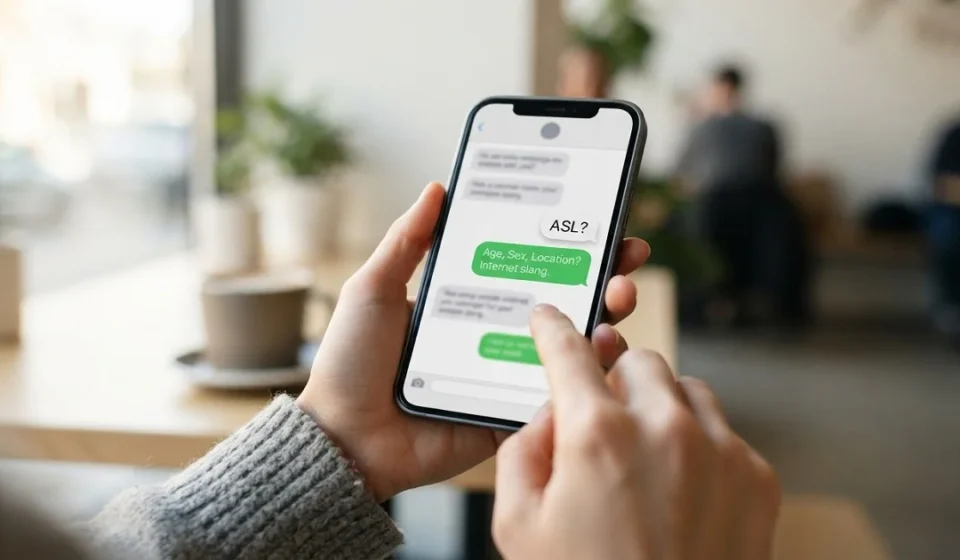
ASL Meaning in Text: What Does ASL Mean in a Text Message?
Ask someone what ASL meaning in text actually is, and most will say “as hell” without missing a beat. Type “I’m tired asl” and you’re just saying you’re really tired nothing more mysterious than that. But the letters carry more baggage than that one answer suggests. Depending on who sent the message and what they’re talking about, ASL might mean “age, sex, location,” a question straight out of 2003-era chat rooms, or it might simply mean American Sign Language.
You can usually tell which one you’re looking at just by paying attention to where the letters sit in the sentence. Tacked onto the end of a description? Probably “as hell.” Standing alone with a question mark? That’s the old “age, sex, location” habit resurfacing. Part of a sentence about signing, interpreters, or Deaf culture? Then it’s the actual language, no slang involved.
What Does ASL Mean in Text?
Picture the word “really” or “very.” Now imagine swapping it out for “asl” and sticking it at the end of the sentence instead of the front. That’s the “as hell” usage in a nutshell.
- “That test was hard asl.”
- “It’s cold asl outside.”
- “She’s funny asl.”
- “I’m tired asl.”
Say “hard asl” and you mean something was genuinely, painfully hard. It’s an intensifier nothing fancier than that, even though it looks like an abbreviation at first glance.
This is the version that dominates casual texting, group chats, and comment sections. If someone under thirty texts you and drops “asl” after a description, this is almost certainly what they mean.
That said, don’t assume it’s automatic. The same three letters do other jobs too, and the sentence around them is what gives it away.
ASL Meaning in Texting and Chat
Drop into any group chat and you’ll probably spot “asl” riding shotgun on the end of a sentence, doing exactly what an intensifier does.
“Bro, that movie was long asl.” The movie dragged. Badly.
“I’m bored asl. Someone text me.” Not mildly bored properly, restlessly bored.
“That fit is clean asl.” A real compliment, dialed up.
Notice the shape: adjective first, “asl” second. It almost never opens a sentence when it’s being used this way.
Flip that around and you get the other meaning. “Age, sex, location” tends to lead, not follow. It shows up as a question “ASL?” or “a/s/l?” usually early in a conversation with someone who doesn’t already know those three things about you. That’s a habit left over from the AIM and Yahoo Messenger days, when nobody had a profile picture, a bio, or a location tag, so people just asked outright.
What Does ASL Stand For?
Three answers cover almost every case you’ll run into.
As hell. Slang, lowercase more often than not, and glued to the end of a phrase. This is the version you’ll meet constantly on TikTok, Snapchat, and in texts between friends.
Age, sex, location. An old internet shorthand, frequently written a/s/l, used to ask for someone’s basic details when you can’t see a profile.
American Sign Language. Not slang at all this is the established meaning, used in schools, workplaces, accessibility notices, and everyday conversation about Deaf culture.
A fourth reading floats around occasionally: “as life,” used the same way as “as hell.” It barely registers compared to the other three, so it’s not something you need to track separately.
One thing worth remembering the slang meaning didn’t push out American Sign Language. They coexist. They just live in completely different kinds of sentences, so confusing one for the other rarely happens once you know what to look for.
ASL Examples in Text Messages
“Ugh, this line is long asl.” As hell the line’s dragging on forever.
“Hey, asl?” Age, sex, location. Someone wants your basics.
“The new episode was good asl, watch it tonight.” As hell again a strong recommendation dressed up as slang.
“We’re hiring someone who knows ASL for the front desk.” American Sign Language, no slang attached it’s a job requirement.
“18/f/ohio, asl?” Age, sex, location. They’ve shared theirs first and now want yours.
“My cousin is deaf so I’ve been taking ASL classes.” American Sign Language.
“That dog is cute asl 😭” As hell, plus the usual dramatic emoji for good measure.
How to Tell Which ASL Meaning Someone Means
None of this requires detective work. A handful of clues does the job.
Where it lands in the sentence matters most. After a descriptive word, with nothing else around it, you’re looking at “as hell.” Standing alone as a question at the start of a conversation, it’s “age, sex, location.”
Punctuation helps too. A question mark leans toward “age, sex, location.” No question mark, and it’s almost certainly the intensifier.
Capitalization is a weaker clue but not nothing lowercase “asl” tends toward slang, capital “ASL” tends toward the older chat-speak or the language itself.
Then there’s the actual topic. If the conversation has anything to do with interpreters, Deaf culture, classes, or accessibility, you’re dealing with American Sign Language regardless of capitalization.
And who’s asking matters just as much as what they’re asking. A stranger opening cold with “asl?” in a DM wants personal information. A friend replying “tired asl” to your story is just talking the way people talk now.
Platform plays a role too short-form apps and group chats skew hard toward the emphasis meaning, while anonymous chat sites are still where the age-sex-location version survives.
Is ASL Still Common in Texting?
The “as hell” sense is genuinely widespread in casual writing, especially among younger users, and it’s common enough now that mainstream references list it right alongside the older definition. Dictionary.com, for instance, defines asl both as the age-sex-location initialism and as slang for the intensifying phrase “as hell” which tells you it’s not some fringe TikTok-only thing anymore.
The age-sex-location version hasn’t vanished, but it’s nowhere near as central as it was two decades ago. Most platforms show a profile, a photo, or a location tag automatically now, so there’s simply less reason to ask outright. Where it survives is mostly on anonymous platforms, where nobody has that information by default.
Nobody has solid public numbers on exactly how often each meaning gets used so be skeptical of any site that hands you a precise percentage. That data doesn’t exist in any rigorous form.
How to Reply When Someone Says “ASL?”
If a friend tacks “asl” onto the end of a sentence, there’s genuinely nothing to respond to. It’s emphasis, full stop same job as “so” or “really.”
If someone opens with “ASL?” and clearly wants your age, sex, and location, you’ve got options. Answer partially if you’re comfortable “20s, guy, east coast” and only if you know who you’re talking to. Ask who’s asking. Redirect the conversation entirely. Or just don’t answer; silence is a complete response too.
Nobody’s entitled to your personal details just because they typed a question mark. This matters most with strangers, since age and location are exactly the information someone with bad intentions would want first. If a stranger pushes after you don’t answer, blocking them is a perfectly reasonable move.
And if someone’s genuinely asking whether you know American Sign Language that’s just a yes-or-no question about a skill, nothing more complicated than that.
ASL vs. Other Common Text Abbreviations
AF does the same job as “as hell,” just with a rougher edge. “Tired af” and “tired asl” mean the same thing.
TBH softens an opinion rather than sharpening it the opposite job of an intensifier.
WYD opens a conversation the way old-school “asl?” did, minus the request for identifying information.
DM shows up constantly in the same conversations where the age-sex-location question tends to appear.
What makes ASL genuinely unusual among these is that it also names a real, established language most texting shorthand doesn’t carry that kind of double life. For more shorthand like this, our guide to common texting abbreviations covers the frequent ones, and our piece on early internet chat slang digs into where phrases like a/s/l actually came from.
Frequently Asked Questions About ASL Meaning in Text
What does ASL mean in a text?
Usually “as hell,” used for emphasis at the end of a phrase “hungry asl,” “hot asl,” that kind of thing.
What does ASL stand for in texting?
“As hell” in modern slang, “age, sex, location” in older chat culture, and “American Sign Language” outside of slang entirely.
Does ASL mean age, sex, location?
Sometimes that reading fits when ASL shows up as a standalone question, often written a/s/l?, usually from someone you don’t already know.
Does ASL mean American Sign Language?
Yes, whenever the conversation touches on signing, interpreters, Deaf culture, or language classes.
Is ASL still used in texting?
The “as hell” version is everywhere in casual messaging. The age-sex-location version is far less common than it once was but hasn’t disappeared entirely.
How do I know which meaning someone intends?
Check placement and punctuation. After an adjective with no question mark, it’s “as hell.” A standalone question, it’s “age, sex, location.” A conversation about language, it’s American Sign Language.
How should I respond to “ASL?”
Share only what you’re comfortable sharing, or skip it entirely. Nobody’s owed your age and location just because they asked for it.
The Takeaway
Three letters, three jobs, and the sentence around them almost always gives it away. Tucked onto an adjective, read it as “as hell.” Asked cold by someone new, read it as “age, sex, location” and decide for yourself whether to answer. Attached to a conversation about communication or Deaf culture, it’s American Sign Language and that meaning was never going anywhere.
Working out what they meant takes a second. Deciding what you’re willing to share back is the part actually worth thinking about.