
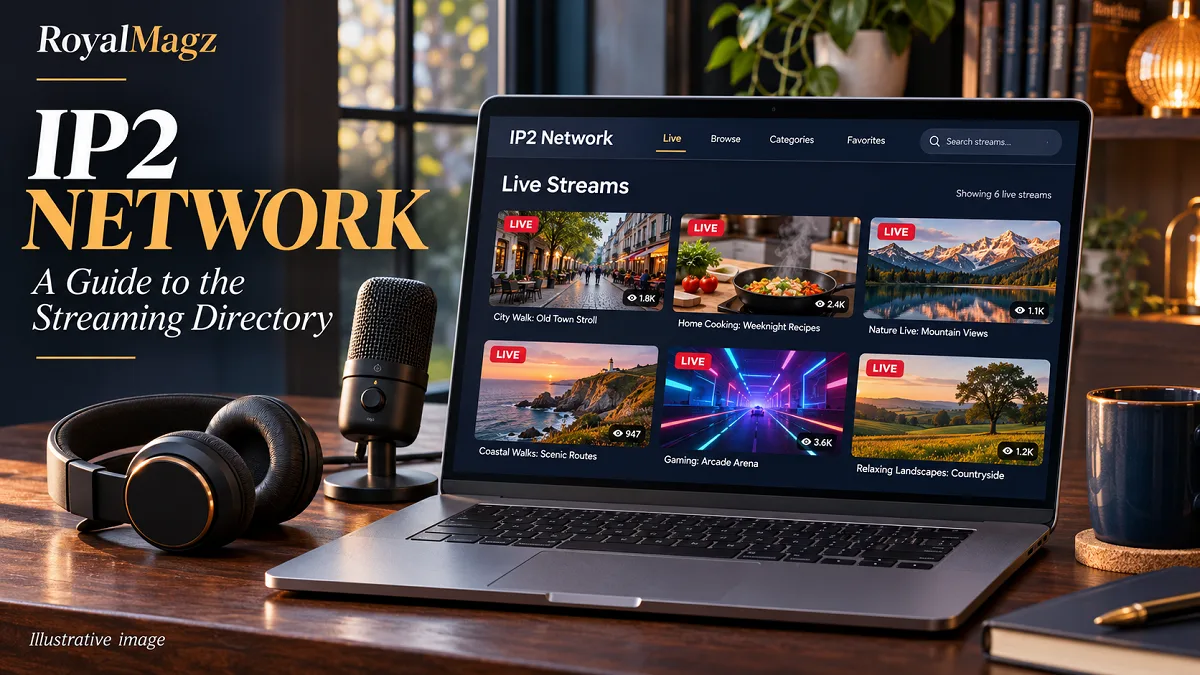
IP2 Network refers here to the website at ip2.network, which identifies itself as a live streamer directory. Its public interface includes online and offline indicators, preview controls, and account options. It is separate from I2P, the privacy network whose name sometimes gets mixed into articles about this search term.
That distinction answers the first question, but visitors often need more: which account should they use, why does a stream fail, and what does a directory actually provide? This guide explains those decisions without treating every claim about the wider streaming community as a verified fact about this particular website.
Table of Contents
1. What Is IP2 Network, and Who Is It For?
Think of a streaming directory as a starting point for finding broadcasts. Its purpose differs from producing a show, operating a creator’s channel, or running the platform that delivers a video. Those roles can belong to different people and services.
For a viewer, that separation matters most when something goes wrong. A missing listing calls for a different check than an unavailable video. A directory account also should not be treated as the same account you use with a video platform.
Who might find a directory useful?
Someone browsing for a broadcast may appreciate a shared starting point. Someone following one particular creator may prefer that creator’s confirmed channel instead. Choose according to the task: discovery benefits from browsing, while checking a creator’s latest announcement calls for a direct source.
RoyalMagz’s Sotwe guide explores a related distinction between a third-party viewer and the original service. The products serve different audiences, but the question is similar: are you looking at the original source or another site’s presentation of it?
Before relying on a listing, compare the creator’s handle and channel address. A familiar display name or copied avatar is a weak basis for identifying an account. If the creator publishes confirmed channel links elsewhere, use those to resolve uncertainty.
2. Where and When Should You Check a Stream?
Start with the exact domain rather than a similar name in a search result. For IP2 Network, this article covers ip2.network only. Claims about another domain, forum, or group should not automatically carry over to it.
Then decide whether you need a live broadcast, a replay, or information about a creator. These are separate searches. A live directory is not necessarily an archive, and an old screenshot cannot establish who is broadcasting now.
Check the original channel when timing matters
If you are waiting for a scheduled event, check the creator’s own announcement and its time zone. If you want an earlier broadcast, look for a replay on the originating channel. Avoid interpreting a missing entry as proof that the creator deleted an account or stopped streaming permanently.
The same caution applies to status counters. Our text retrieval displayed zero online and offline entries, but it did not establish a complete live roster. A retrieved page can lack information that loads separately. We therefore cannot use that snapshot to measure the community’s size or current activity.
When sharing a stream with someone, send the specific channel or broadcast address where possible. A general directory link may show different listings by the time another person opens it. Add the creator’s name and the event date if those details matter.
3. How Should You Handle Accounts and Playback?
The public IP2 Network interface offers registration and login. Its registration form requests a username and password, with email described as optional for recovery. Those visible fields do not establish what every account feature does, and we did not create an account to test them.
Before registering, identify a feature you actually need. Do not assume registration provides private streams, platform subscriptions, or access to a creator’s account. Read the explanation beside the feature rather than relying on a third-party tutorial that may describe an older version.
Keep directory and platform credentials separate
Use a unique password if you choose to register. When a video service asks you to sign in, inspect the address before entering its credentials. A directory’s login form should not become a place to try the passwords you use for unrelated services.
Save the account details securely and think about recovery before skipping an optional email field. Convenience at signup can become an inconvenience later if you forget your password. Avoid sharing accounts with strangers offering access to unavailable broadcasts.
Troubleshoot the video at its source
If a player fails, open the original video page when that option exists. Compare the result: a working original suggests a problem with the embedded presentation; an unavailable original points toward the video or its host.
YouTube, for example, explains that age-restricted videos generally cannot play on most third-party websites. Viewers must meet its account and age requirements on YouTube. This illustrates why an embedded player can fail without proving that an entire directory has closed.
For ordinary playback errors, check your connection, update the browser, and try a lower resolution on the original video service. YouTube’s troubleshooting guidance includes these checks. Do not install an unfamiliar player merely because a pop-up promises to fix the stream.
4. What Should You Check Before Trusting IP2 Network?
A useful directory and a trustworthy account service are separate judgments. Consider what you intend to do: browsing a public page, registering, making a payment, and downloading software each involve different decisions. Approval of one action should not automatically justify the others.
Our review did not establish a verified legal owner or launch date. The homepage links to privacy and terms pages, but those destinations returned 404 errors during our retrieval. That limits what we can confirm about the published rules; it does not, by itself, establish fraud.
Look for explanations before sharing information
If policies remain unavailable in your browser, postpone registration until you can understand the terms. Check what information the operator requests, why it is needed, and how account problems can be reported. A contact address alone does not answer those questions.
Treat unexpected payment requests separately from the directory’s existence. Confirm the recipient and the service being purchased before proceeding. Do not assume a donation link belongs to a creator simply because it appears near that creator’s name.
Also consider what is suitable for your audience before playing a live broadcast on a shared screen. A preview cannot guarantee what someone will say next. Parents should assess the actual channel rather than infer an age rating from a directory’s design.
If you want another example of evaluating an entertainment website, our Mangago guide discusses domain identity and content sourcing. Use those checks as questions to investigate, not as evidence that unrelated websites share owners or practices.
If a channel appears to impersonate someone, record its public address and report it through the relevant platform. Avoid repeating accusations in comments; identifying a mismatch is useful, while guessing about motives adds little value.
5. Why Is IP2 Network Different From I2P?
The spelling is easy to confuse, but the services have different purposes. The official I2P project describes a decentralized network designed for private communication. Its documentation concerns encrypted connections and network participation, rather than finding livestream creators.
Do not follow I2P installation instructions merely because you searched for IP2 Network. First identify your goal. Looking for a broadcast calls for a channel or directory; researching private networking calls for the project’s own documentation.
Equally, browsing a streaming directory should not be described as obtaining anonymous internet access. Nothing in the directory features reviewed supports that claim. Articles that merge the two names can send readers toward irrelevant downloads and leave their original question unanswered.
Frequently Asked Questions
Does a directory listing prove a partnership?
No. Treat a listing as a discovery aid unless the parties confirm a relationship. Check the creator’s own channels before describing anyone as an official member, employee, partner, or representative.
Should you trust a replacement domain?
Only after checking evidence connecting it to the service you intended to visit. A matching name, similar design, or search ranking is not enough. Avoid moving account credentials to an unverified replacement page.
What should a first-time visitor do?
Confirm the domain, find the intended creator, and check the original channel before registering or paying. Keep the directory’s role separate from the video host’s role. That makes access problems easier to understand and keeps your decisions tied to evidence.