
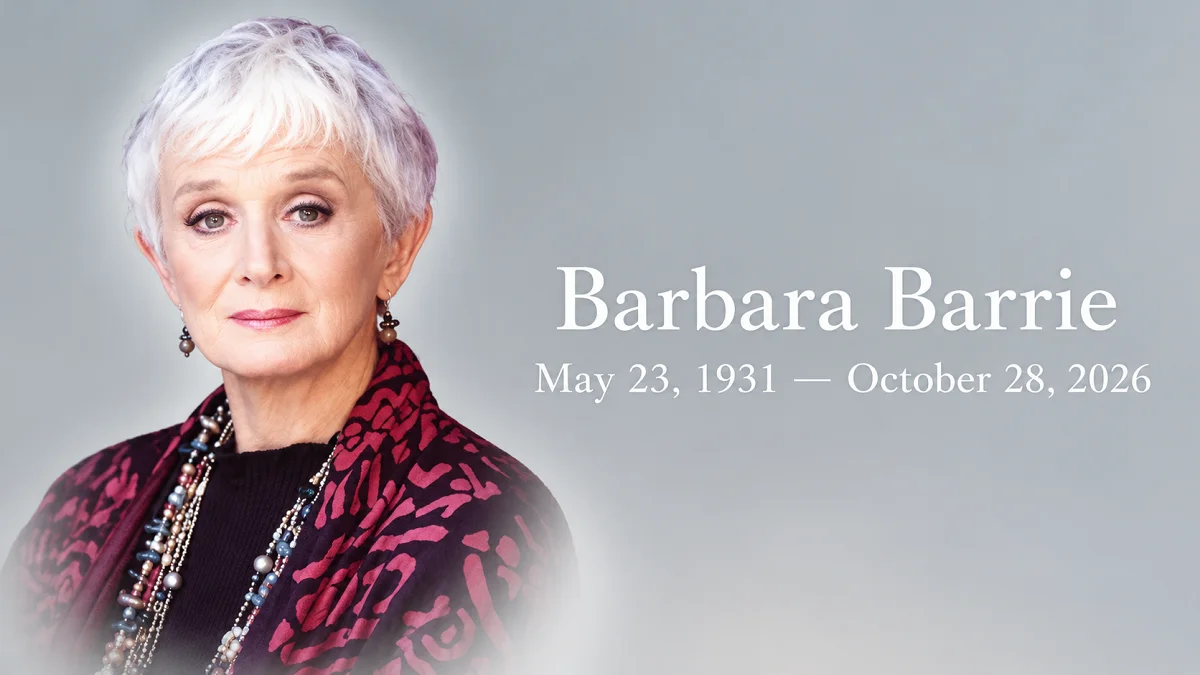
Barbara Barrie, the Oscar-nominated actress celebrated for her work in Breaking Away, Barney Miller, and Broadway’s Company, died on October 28, 2026. She was 95 years old.
Her daughter, Jane Harnick, confirmed that the actress died at her Manhattan home after receiving a terminal cancer diagnosis. Her death was medically assisted, according to statements reported by major US news outlets.
Barrie’s death brought renewed attention to an acting career that stretched across seven decades. She earned recognition in film, television, and theater while also writing books about her experience with cancer.
For many viewers, she remains best remembered for playing believable mothers and grandmothers. Yet her career included challenging dramatic performances, award-winning stage work, and roles that addressed difficult social issues.
Table of Contents
How Did Barbara Barrie Die?
Barbara Barrie died at her home in Manhattan, New York, on Wednesday, October 28, 2026.
Her daughter, Jane Harnick, confirmed the death to The New York Times. According to People’s report on Barbara Barrie’s death, the actress had received a terminal cancer diagnosis and chose medical assistance in dying.
Her representative also confirmed that her death occurred under New York’s Medical Aid in Dying law.
The circumstances attracted public attention because New York had only recently introduced its medical aid in dying program. However, the family’s announcement centered on Barrie’s illness and her end-of-life decision.
What Was Barbara Barrie’s Cause of Death?
The confirmed information establishes that Barrie had terminal cancer and that her death was medically assisted.
As of October 29, 2026, the available reporting does not identify the specific type of cancer behind her final diagnosis. It would therefore be inaccurate to name a particular cancer as the confirmed terminal illness.
Barrie had previously spoken publicly about another cancer diagnosis in 1994. That earlier medical history is well documented, but it should not automatically be treated as the explanation for her final illness.
The distinction matters because a person’s past diagnosis does not establish the exact nature of a later medical condition.
What Does Medical Aid in Dying Mean?
Medical aid in dying is a legally regulated end-of-life option available to qualifying terminally ill adults in certain US states.
New York’s Medical Aid in Dying law took effect on August 5, 2026. It permits eligible adult residents with a medically confirmed terminal illness and a prognosis of six months or less to request medication that they may choose to self-administer.
The law includes safeguards involving medical evaluations, informed consent, and decision-making capacity.
According to the New York State Department of Health, the program provides an additional option for eligible patients facing a terminal illness.
Barrie’s representative said she had supported the legislation. Her reported decision took place after the law became effective.
Medical aid in dying is a sensitive subject with differing medical, religious, and ethical perspectives. The circumstances of Barrie’s death should be understood through the confirmed family statements rather than speculation about her private treatment.
Who Was Barbara Barrie?
Barbara Barrie was an American actress and author whose career included major motion pictures, television comedies, dramatic series, and Broadway productions.
She was born Barbara Ann Berman on May 23, 1931, in Chicago, Illinois.
Her family later lived in Corpus Christi, Texas, where she spent much of her childhood. She attended school there before pursuing higher education at the University of Texas at Austin.
Barrie earned a Bachelor of Fine Arts degree in 1953. She subsequently moved into professional acting, a decision that led to decades of work across several entertainment industries.
Her early career developed during a period when opportunities for women in American theater and television were changing. Rather than building her reputation around a single character type, she gradually established herself in both comedy and serious drama.
In 1955, she made her Broadway debut in The Wooden Dish. Television appearances followed during the second half of the decade.
These early performances provided the experience that helped her move between stage and screen throughout her career.
Barbara Barrie’s Film Career and Major Breakthroughs
Barrie’s film career included independent dramas, popular comedies, and award-nominated performances.
Her work often emphasized the emotional details of ordinary family life. She could make a supporting character feel important without turning that character into the center of every scene.
Two films in particular established her reputation among critics and movie audiences.
One Potato, Two Potato (1964)
One of her earliest major achievements came with One Potato, Two Potato, a 1964 American drama directed by Larry Peerce.
Barrie played Julie Cullen Richards, a divorced white woman who marries a Black man, Frank Richards, portrayed by Bernie Hamilton.
Their relationship becomes the center of a custody dispute involving her child.
The film addressed interracial marriage and prejudice at a time when such relationships faced legal and social restrictions in parts of the United States.
Its subject was especially significant because the Supreme Court did not invalidate state bans on interracial marriage until 1967.
Barrie’s performance received international recognition at the 1964 Cannes Film Festival, where she shared the Best Actress award with Anne Bancroft.
The recognition showed her ability to carry emotionally demanding material and brought wider attention to her dramatic work.
Breaking Away (1979)
For many moviegoers, Barrie’s defining film performance came in Breaking Away, the 1979 coming-of-age comedy-drama directed by Peter Yates.
The story follows Dave Stohler, a young man in Bloomington, Indiana, who becomes fascinated with competitive cycling and Italian culture.
Barrie portrayed his mother, Evelyn Stohler, opposite Paul Dooley as his father.
Her character brings warmth and emotional balance to a story involving ambition, class differences, friendship, and family expectations.
The performance earned her an Academy Award nomination for Best Supporting Actress at the 1980 Oscars.
Although she did not win, the nomination placed her among the year’s recognized supporting performers. The film also received a Best Picture nomination and won the Oscar for its original screenplay.
Barrie later returned to the same character in the short-lived television adaptation of Breaking Away.
That performance earned her an Emmy nomination in 1981.
Her Most Memorable Television Roles
Television introduced Barbara Barrie to viewers who might never have encountered her theater work or independent films.
Over the years, she appeared in sitcoms, crime dramas, family programs, and guest roles.
Her ability to move between comedy and drama allowed her to remain active as television storytelling changed.
Barney Miller
Barrie played Elizabeth Miller, the wife of Captain Barney Miller, on the ABC sitcom Barney Miller.
The show centered on the daily lives of detectives working in a New York City police precinct.
Her appearances offered a glimpse into the captain’s family life beyond the workplace.
Although the series primarily followed police officers and their investigations, Elizabeth helped establish another side of its central character.
Barrie’s understated performance complemented the show’s character-driven humor.
Suddenly Susan
Another familiar television role came in Suddenly Susan, the NBC sitcom starring Brooke Shields.
Barrie played Helen, commonly called Nana, the grandmother of Shields’ character.
Her performance introduced her to a younger generation of television viewers during the 1990s.
The character reflected Barrie’s skill at creating lively family relationships through dialogue, timing, and personality.
She could communicate affection and disagreement without making every family scene feel overly sentimental.
Law & Order and Other Television Work
Barrie also appeared in dramatic series, including Law & Order and Law & Order: Special Victims Unit.
Her guest performances received Emmy nominations in 1992 and 2003, respectively.
Additional television credits included The Twilight Zone, The Alfred Hitchcock Hour, Family Ties, thirtysomething, Dead Like Me, and Nurse Jackie.
These appearances demonstrate how consistently she worked across changing television eras.
Some audiences recognized her from a single sitcom, while others encountered her through guest appearances or dramatic roles.
A Distinguished Broadway and Theater Career
Although television brought her into American homes, theater remained central to Barrie’s professional life.
She built a substantial stage career that included Broadway musicals, dramatic plays, and Off-Broadway productions.
One of her best-known stage roles was Sarah in the original 1970 Broadway production of Stephen Sondheim and George Furth’s Company.
The musical examined marriage, relationships, and the uncertainties of adult life through an ensemble of New York characters.
Barrie’s performance earned her a Tony Award nomination for Best Featured Actress in a Musical in 1971.
She also appeared in Neil Simon’s California Suite and performed in productions of The Prisoner of Second Avenue.
Her Off-Broadway performance in The Killdeer brought her Obie and Drama Desk recognition in 1974.
Decades later, she continued to appear on Broadway. Her credits included Torch Song Trilogy and the 2017 production of Significant Other.
Her stage record shows that she was far more than a familiar television supporting actress.
She maintained a serious theatrical career while moving between major entertainment formats.
Awards and Recognition Throughout Her Career
Barbara Barrie received nominations and awards across film, theater, and television.
Her major achievements included:
- 1964: Cannes Film Festival Best Actress award for One Potato, Two Potato, shared with Anne Bancroft.
- 1971: Tony Award nomination for Best Featured Actress in a Musical for Company.
- 1974: Obie and Drama Desk recognition for The Killdeer.
- 1980: Academy Award nomination for Best Supporting Actress for Breaking Away.
- 1981: Emmy nomination for the television adaptation of Breaking Away.
- 1992: Emmy nomination for Law & Order.
- 2003: Emmy nomination for Law & Order: Special Victims Unit.
Recognition from these different organizations illustrates the range of her professional work.
Her career did not depend on one major award or a single famous character. Instead, she continued earning respect through performances in different roles and settings.
Barbara Barrie’s Cancer History and Advocacy
Long before her final illness, Barrie had spoken openly about her experience with colorectal cancer.
In 1994, she was diagnosed with rectal cancer and underwent treatment that included a colostomy.
Rather than keeping the experience entirely private, she later wrote about the emotional and practical challenges associated with her diagnosis.
Her books included Second Act and Don’t Die of Embarrassment: Life After Colostomy and Other Adventures.
The latter discussed living after colostomy surgery and the embarrassment or anxiety some patients experience when confronting major changes to their bodies.
Her writing approached these subjects through personal experience rather than medical instruction.
She also encouraged greater awareness of colorectal cancer and the importance of discussing symptoms and treatment without shame.
Barrie had separately disclosed a diagnosis of idiopathic pulmonary fibrosis in 2014, a chronic condition that affects lung tissue.
Neither that diagnosis nor her earlier rectal cancer history should be assumed to identify the specific terminal cancer reported in October 2026.
Her public health advocacy remains an important part of her record beyond acting.
Family, Marriage, and Personal Life
Barbara Barrie married theater director and producer Jay Harnick in 1964.
Harnick was associated with TheaterWorksUSA, an organization known for bringing theatrical productions to young audiences.
The couple had two children, Jane Harnick and Aaron Harnick.
Their marriage lasted until Jay Harnick’s death in 2007.
Barrie was survived by her daughter, her son, and three granddaughters.
Her daughter Jane became the family member publicly identified in reporting about her death.
Although Barrie spent much of her professional life in the public eye, her family relationships were not generally the focus of her career coverage.
Her work, interviews, and books provide a fuller account of her public life than speculation about private family matters.
Barbara Barrie’s Lasting Legacy
Barbara Barrie’s career offers an example of how an actor can remain influential without always occupying the leading role.
In One Potato, Two Potato, she portrayed a woman facing prejudice and a difficult family conflict.
In Breaking Away, she brought warmth and credibility to a working-class household.
On Barney Miller and Suddenly Susan, she created memorable supporting characters that helped make fictional families believable.
Her Broadway work also showed a strong connection to live performance, while her award nominations reflected recognition across several branches of entertainment.
Away from acting, Barrie used her experience with cancer to address subjects that many patients found uncomfortable to discuss openly.
She left behind films, television performances, stage credits, and books that continue to document different sides of her work.
Her death on October 28, 2026, ended a long professional life, but her performances remain available for audiences discovering American film and television history.
For viewers who remember her as Evelyn Stohler, Elizabeth Miller, or Nana, Barbara Barrie’s legacy rests in the humanity she brought to those characters—and in the decades of work that extended well beyond them.