

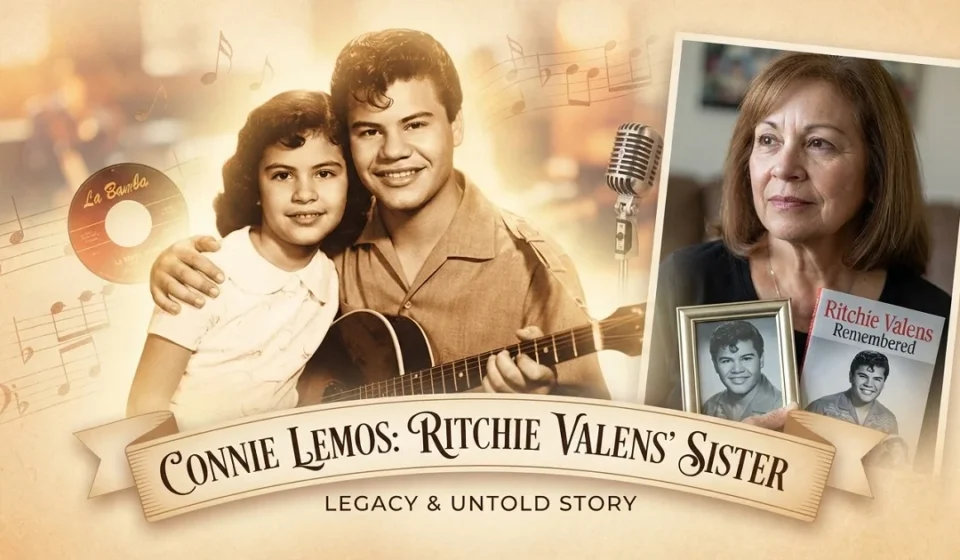
Connie Lemos: Ritchie Valens’ Sister, Legacy & Untold Story
Connie Lemos is best known as the younger sister of rock ’n’ roll pioneer Ritchie Valens, the musician behind “La Bamba” and “Donna.” While the world remembers Ritchie for his music and his tragically short career, Connie remembers him in a much more personal way—as her older brother, father figure, and friend.
Connie was just 8 when Ritchie died in the 1959 plane tragedy that also took Buddy Holly and J.P. “The Big Bopper” Richardson. His death altered her family permanently and for years Connie could not bear to look at his photographs or listen to his music.
Her recollections offer a view of Ritchie Valens that is missing from the popular accounts of his short music career. But there was no fledgling rock star, just Ritchie, home in Pacoima. So, Connie’s story is much more than a narrative of a brilliant athlete, it’s a story of family and brotherhood the fight to preserve alive memories that began more than half a century ago.
Who Is Connie Lemos?
Connie Lemos is the younger sister of Ritchie Valens, the California-born musician who became one of the early Latino pioneers of American rock ’n’ roll.
Connie grew up with Ritchie and his other siblings in the Pacoima area of Los Angeles. At home, she did not see him as the celebrity that later generations would come to know. In a 2001 Los Angeles Times article, Connie described the simple difference between Ritchie’s public image and the person her family knew: at home, he was simply “Ritchie.”
That distinction is important when understanding Connie’s story.
Ritchie’s professional career lasted only a short time, but his role inside the family was much bigger than his time on stage. Connie has spoken about him as a brother who was also a father figure and a close friend while she was growing up.
Connie Lemos and Ritchie Valens
The answer is Ritchie Valens. Born Southern California, 1941. His passion of music made him one of the most popular youths of the late 1950s.
His achievement did not affect the core bond between them, however, for Connie.
He was just a man looking out for his sisters to her. The Los Angeles Times said that Ritchie would entertain his small sisters with songs and guitar in the garden. Things remembered decades before his ascent to stardom as a music artist, emblematic of ordinary life within his family.
The significance of Connie’s memories is that they reveal a side of Ritchie that is often overlooked when his life is condensed into a brief biography.
He was not only the teenager who recorded hit songs. He was also a brother growing up in a working-class California family.
What Was Ritchie Valens Like as a Brother?
Connie has repeatedly described Ritchie as an important figure in her childhood.
In interviews she has said he was more than an elder brother to her. She had thought of him as a parent, a friend, a man to be respected. That bond goes some way to explaining why she was so impacted by his death.
A report from the Los Angeles Times in 1987 also included recollections of Ritchie’s sisters about the family. A second sister, Connie Jr., said Ritchie was always there for his younger sisters and the kind of sibling they could count on during other family hardships.
This is one reason it is useful to separate Ritchie Valens the performer from Ritchie Valens the family member.
Millions of people know his songs. Connie knew the person behind them.
Connie Was Only Eight When Ritchie Died
The loss of Ritchie Valens was particularly difficult for Connie because she was still a child.
Ritchie died in an aircraft accident with Buddy Holly and J.P. Richardson in Clear Lake, Iowa, on February 3, 1959. It was subsequently to be remembered as the “Day the Music Died.”
Connie was eight years old at the time.
In a 2025 interview with People, she expressed how hard it was to accept Ritchie was indeed gone. For years she couldn’t look at his images, couldn’t listen to his music, the void he left was so awful, she said.
Her childhood memories show just how different the tragedy was for the family compared with the way history remembers it.
For music fans, February 3 became a famous date in rock history.
For Connie, it was the day her older brother disappeared from her life.
How Ritchie’s Death Affected Connie
Grief did not simply disappear as Connie grew older.
In an interview released by ListenIowa Connie said how she made up a pretend reason for Ritchie disappearing as a youngster. She fantasized that maybe he had lived and that someone had discovered him and that he did not know who he was.
That memory gives an unusually personal picture of childhood grief.
Connie has said that she didn’t speak about Ritchie for years. She protected his link with her even from others around her. In the same interview she said she did not have any pictures or albums or anything else that would be a memory of him in her house for a long period.
She has also spoken about how difficult it was to hear his songs unexpectedly.
The music that millions of fans heard as exciting rock ’n’ roll could bring back painful memories for someone who had lost the person who made those recordings.
La Bamba and Connie Lemos
The 1987 film La Bamba introduced Ritchie Valens’ story to a much wider audience.
Directed by Luis Valdez, the film starred Lou Diamond Phillips as Ritchie and told a dramatized version of the singer’s life, rise to fame, relationships, family struggles, and final days. The movie became an important part of how later generations learned about Valens.
For Connie, however, watching the story appear on screen was much more personal.
It brought back painful memories, but it also helped me begin to process emotions that I had been holding inside for years,” she said. Ultimately, La Bamba says the song helped her and the family move toward a new connection with Ritchie’s memories.
The video should not be taken as a pristine historical document. As with other biopic movies, it takes some artistic license with events and people to convey a tale. Director Luis Valdez has also spoken about the research and family participation that went into the original film.
Still, its cultural impact was significant.
It introduced Ritchie Valens’ music and story to people who had not been alive when he was performing.
Connie’s Experience With the La Bamba Film
One particularly emotional part of the production involved Connie visiting the set.
Later, Lou Diamond Phillips, who portrayed Ritchie, remembered that Connie had been to the set as the team was shooting the scene when Ritchie boarded the jet. For Phillips, the event was “very emotional” since it repeated her brother’s last voyage, she added.
The experience illustrates why making La Bamba was different for the Valens family than it was for the filmmakers.
For the production team, it was a historical scene being recreated.
For Connie, it represented a real event that had changed her childhood forever.
Ritchie Valens’ Musical Legacy
Ritchie Valens had an extraordinarily short career.
He was only 17 when he died, yet he had already made a lasting impression with songs including “Come On, Let’s Go,” “Donna,” and “La Bamba.”
La Bamba” would be especially meaningful to his legacy. It was based on a traditional Mexican folk song, but Ritchie turned it into a rock-and-roll version that appealed to a broad American audience.
That combination mattered.
Ritchie was among a handful of young Mexican-American musicians who helped show that Latino artists might have a place in the quickly changing American rock-and-roll scene.
His career was short, but his influence continued long after his death.
Why Connie’s Perspective Matters
There are countless articles about Ritchie Valens as a musician.
Far fewer focus on what he meant to the people who knew him personally.
That is where Connie Lemos’ story becomes especially meaningful.
She remembers Ritchie before the fame, before the records, and before La Bamba became part of popular culture. Her memories provide a family perspective that cannot be captured by chart positions or record sales.
She also represents the people who lived with the consequences of his death long after the headlines disappeared.
For Connie, remembering Ritchie has been a lifelong process.
Connie Lemos and Ritchie’s Legacy Today
Connie has continued to speak about her brother and his legacy.
The Ritchie Valens family website describes Connie as someone who participates in events connected to Ritchie’s memory and helps share his story. It also says she and family members remain involved with the annual Winter Dance Party in Clear Lake, Iowa.
Her involvement has allowed fans to hear about Ritchie from someone who actually knew him.
She has also spoken publicly about how his music continues to reach new generations.
In a 2025 People interview, Connie reflected on the fact that Ritchie’s music had survived for decades. She specifically discussed the continuing popularity of “La Bamba” and how his music allows people to remember him even though he died so young.
That may be one of the strongest parts of Ritchie Valens’ legacy.
His life ended at 17, but his music did not.
Ritchie Valens, “American Pie,” and the Day the Music Died
Ritchie’s death also became part of another famous piece of music history.
Don McLean later referenced the 1959 plane crash in “American Pie,” his famous 1971 song. Connie has spoken about hearing the song and realizing that McLean was singing about her brother and the other musicians who died in the crash.
For Connie, the song became another unexpected way in which Ritchie’s memory continued to reach the public.
The tragedy had become part of American popular culture, but Connie’s perspective remained personal. She has expressed gratitude that music continued to help people remember what happened and who Ritchie was.
The Family Behind the Famous Name
One of the most interesting things about Connie Lemos’ story is how ordinary Ritchie remained inside his family.
Outside the home, he was becoming a teenage rock star.
Inside the home, he was still a brother.
That contrast is central to understanding Connie’s memories.
Ritchie’s fame grew rapidly during the final months of his life. His family had to adjust to a level of public attention they had never experienced before. A 1987 Los Angeles Times report described how the family became involved in issues surrounding Ritchie’s music, recordings, and rights after his death.
Thus the family had more to contend with [] than plain grief. And dealt with the complicated legacy of a young musician whose career really hadn’t even started.
Frequently Asked Questions
Who is Connie Lemos?
Ritchie Valens’s sister Connie Lemos speaks in front of a headline about the Feb. At the time of Ritchie’s death in 1959, she was still only eight.
Is Connie Lemos Ritchie Valens’ sister?
Yes. Connie Lemos is one of Ritchie Valens’ younger sisters and has spoken publicly about her relationship with him and his lasting legacy.
How old was Connie Lemos when Ritchie Valens died?
Connie was eight years old when Ritchie Valens died in the 1959 plane crash.
What was Ritchie Valens like as a brother?
According to Connie’s recollections, Ritchie was an important figure in her childhood. She has described him as a brother, friend, and father figure.
What did La Bamba mean to Connie Lemos?
The 1987 film brought painful memories back for Connie, but she has also said that it helped her process the grief she had carried for many years.
Did Connie Lemos know Ritchie before he became famous?
Yes. Connie grew up with Ritchie and knew him as her older brother before his music career made him famous. Her memories often focus on the family life they shared in Pacoima.
What is Ritchie Valens best known for?
His biggest successes included ”La Bamba,” ”Donna” and “Come On, Let’s Go. He is also recognized as a notable early Mexican-American rock and roller.
Why is Ritchie Valens still remembered?
Although he died in 1959, his music lived on, and one of the most famous songs associated with him was “La Bamba.” The 1987 motion picture Nabisco laid his story of lo, new misfunction a novelist inducted into Los Angeles Husband’s Fed in 1988.
Does Connie Lemos still talk about Ritchie Valens?
Yes. If you’re interested, Connie has done a number of interviews involved with events that she participates from time to time that pays tribute to her brother stories about him and the music, etc.
Final Thoughts
The story of Connie Lemos adds a different perspective to the history of Ritchie Valens.
To fans of music, Ritchie is more of a teenage rock-and-roll trailblazer cut down before his talents had begun to properly flower. To Connie, he was something far more personal: an older brother who influenced her childhood and whose unceremonious death altered the course of her family eternally.
Her memories also show why Ritchie’s legacy cannot be measured only by his recordings.
His music passed from generation to generation, his story provided the basis of La Bamba, and an enduring legacy in rock history that has never faded. But still, beneath all that was a family who knew him before the fame.
Connie’s willingness to share those memories helps keep that part of the story alive.
Ritchie Valens left the world at only 17, but through his music and his family and the people still telling his story the quiet part of pop culture history also lives on in music.
About RoyalMagz
RoyalMagz is an online magazine with valuable tips, lifestyle, technology, business, fashion & entertainment. We also look at online trends and digital culture, like AnonIBs, to provide readers more context on the stories, platforms and conversations that are influencing the internet. We write our material in a straightforward, practical, easy-to-read language. That way, visitors can quickly discover the information they need without any additional clutter.