
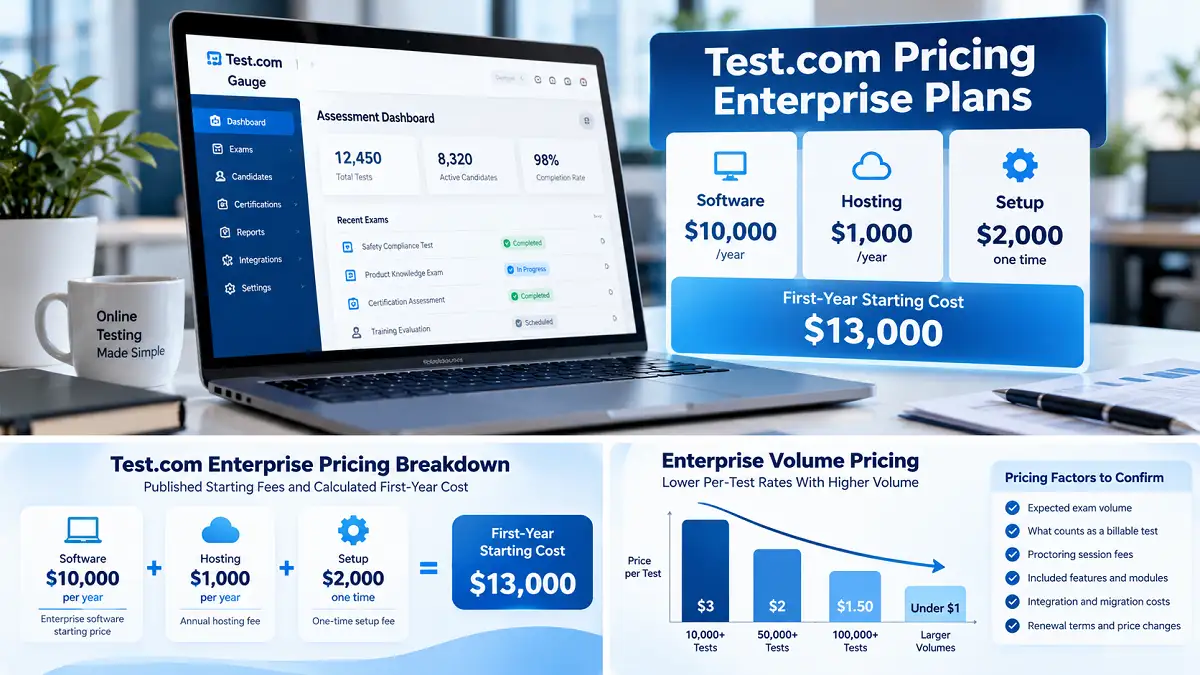
Test.com pricing enterprise plans refer to Gauge, the exam delivery and certification software operated by Test.com, Inc. Gauge lists $10,000 annual software, $1,000 hosting, and $2,000 one-time setup. Together, that is a $13,000 first-year starting calculation, not a universal quote.
For programs delivering more than 10,000 exams annually, Gauge also advertises volume pricing starting at $3 per test. The public fees and volume-based proposals may use different billing structures. A written quote must settle the billing method and total cost.
Table of Contents
What Is Test.com, and Why Is the Product Called Gauge?
Test.com, Inc. provides online assessment and certification technology under the Gauge name. Its published terms identify Gauge as a division of Test.com, Inc., so references to Test.com pricing and Gauge pricing concern the same vendor rather than two unrelated subscriptions.
Gauge serves associations, training providers, and organizations administering formal assessments. The platform handles exam delivery, candidate management, credentials, and integrations with other systems.
Buyers should review Gauge’s current product pages for accurate Test.com pricing.
Readers researching test.com pricing enterprise plans should review Gauge’s official pricing information because the company markets its assessment software under the Gauge name.
Test.com Pricing Enterprise Plans at a Glance
Gauge publishes two main plan categories: Professional and Enterprise. The table separates advertised fees from calculated totals.
| Pricing component | Professional | Enterprise |
|---|---|---|
| Starting software fee | $750/year | $10,000/year |
| Hosting fee | $250/year | $1,000/year |
| One-time setup fee | $500 | $2,000 |
| Calculated first-year starting total | $1,500 | $13,000 |
| Calculated software plus hosting after setup | $1,000/year | $11,000/year |
| Intended program | Growing testing operations | More than 10,000 tests/year |
| Usage structure | Eight usage-based levels | Volume pricing starts at $3/test |
The numbers come from the official Gauge pricing page. Calculated totals are not vendor quotes; usage and optional services can change the bill.
The $11,000 later-year estimate assumes unchanged rates and no repeat setup charge; it is not a renewal quote.
How the $13,000 First-Year Figure Works
Software Subscription: Starting at $10,000 Annually
The Enterprise software fee provides a starting point for budgeting. However, its public label does not tell a purchaser exactly how many exams, administrator accounts, or added modules the agreement covers. Confirm them in the proposal.
Hosting: $1,000 Annually
Gauge lists hosting separately from its Enterprise software starting price. That makes the published starting recurring components $11,000 per year before other charges. Ask what hosting covers, including storage and availability.
Setup: $2,000 One Time
Setup affects the initial budget, not annual charges. Ask whether it covers imports and administrator training.
Using the advertised starting figures, the calculation is simple: $10,000 + $1,000 + $2,000 = $13,000. Check which extras apply.
For test.com pricing enterprise plans, the $13,000 figure represents a calculated starting cost. Actual charges depend on the services, exam volume, and contract terms.
How Enterprise Volume Pricing Changes the Picture
Understanding test.com pricing enterprise plans requires looking beyond annual software fees. Exam volume and per-test rates can significantly affect the total cost.
Gauge positions Enterprise for organizations that need more than 10,000 tests per year. On its pricing page, the vendor states that Enterprise volume rates start at $3 per test and decline as volume increases. Its largest customers may pay under $1 per test.
Those statements do not reveal a complete public volume schedule. The site does not publish a complete rate table or explain whether volume quotes replace or add to base fees.
Consider an organization expecting 12,000 exams next year. Multiplying 12,000 by $3 gives $36,000. This is only a mathematical illustration of a uniform rate. It is not a Gauge quote, and it would be misleading to add $36,000 to the $13,000 starting calculation without confirmation of the contract terms.
Request included exam counts, rate tiers, and a definition of a billable test. Clarify whether retakes or canceled sessions count.
What Does Gauge Enterprise Provide?
Enterprise is not simply a larger number of online quizzes. Gauge describes a broader set of tools for managing testing programs at scale. Its Enterprise product page identifies several relevant capabilities.
Exam Administration and Credential Management
Organizations can manage exams and certification records. Gauge also presents certification, badging, lessons, and eCommerce among its Enterprise capabilities. However, a feature appearing on a product page does not confirm that every function is included in every contract without an extra charge.
Integrations With Existing Business Systems
Gauge advertises a REST API, webhooks, and single sign-on. These tools can link exam records to a learning management system, customer database, or member portal. Confirm implementation limits.
Access Controls and Reporting
Gauge lists audit trails, authentication controls, IP restrictions, and user-level permissions for larger organizations. These help document exam access and administrator changes.
Verify the configuration against your compliance requirements.
Extra Costs to Confirm Before Signing
The final cost of test.com pricing enterprise plans may increase when organizations require additional proctoring, certification features, data migration, or custom integrations.
Proctoring sessions. Gauge’s pricing page says proctoring is priced per session and included in a customer’s quote. In other words, an integrated workflow does not necessarily make monitored exam sessions free. Ask for the applicable rate, whether human and automated monitoring cost different amounts, and how rescheduled sessions are handled.
Certification and badging modules. Gauge showcases these functions under Enterprise, but another vendor-published pricing discussion describes certification and badging as separately priced. That difference makes written confirmation necessary. Identify the exact modules and quantities in the offer.
Migration and integrations. Moving question banks, historic exam results, credentials, or user records can involve work beyond opening an account. Request the implementation scope, who is responsible for mapping data, and the cost of any custom connection.
Payment processing and support. If candidates pay exam fees online, clarify transaction and payment-provider charges. Also ask what level of support is included, whether there are response-time commitments, and whether additional administrator training costs extra.
Not every listed item necessarily carries a separate fee.
Professional vs. Enterprise: Which Plan Fits?
Professional starts much lower on the public price list: $750 for annual software, $250 for hosting, and a $500 setup fee. That creates a $1,500 first-year starting calculation. Gauge also describes eight usage-based pricing levels for this category.
Enterprise has a $13,000 calculated first-year starting total but targets organizations administering more than 10,000 tests yearly. The published Enterprise materials emphasize custom integrations, administrative controls, and high-volume certification workflows.
An organization with a small exam program should not assume that Enterprise is necessary merely because it has many employees. The more meaningful variables are annual exam volume, required security controls, certification complexity, and integration needs.
Also consider the administrative work and integration costs left out of software fees.
Enterprise pricing structures differ across software providers. For another example, RoyalMagz’s BackToFrontShow Pricing article explains how published subscription fees compare with custom enterprise quotes.
A Better Way to Estimate Your Actual Budget
Prepare an internal cost worksheet before contacting sales. Start with the number of live exams expected over the next 12 months, and include the possibility that enrollment will grow.
When comparing test.com pricing enterprise plans, organizations should request detailed estimates based on expected exam volume, implementation requirements, and annual renewal costs.
| Budget question | What to record |
|---|---|
| Annual exam volume | Expected tests and reasonable high-volume scenario |
| Base software and hosting | Quoted amount and what it covers |
| One-time implementation | Setup, migration, and required integration work |
| Exam usage | Included volume, unit pricing, and overage rules |
| Proctoring | Expected monitored sessions and rate per session |
| Other modules | Credentialing, learning, or payment features required |
| Renewal | Next-year fees and terms for increases |
Ask for two written totals: expected first-year cost and next-year cost. Request a higher-volume scenario using the vendor’s actual rates.
This approach makes price comparisons more useful. It also exposes contract questions that can be missed when a team looks only at the published $10,000 annual software figure.
Seven Questions to Ask Gauge Before Buying
Before comparing test.com pricing enterprise plans with other assessment platforms, buyers should clarify the contract terms, included features, and possible additional charges.
- Is the volume rate part of the quoted platform price or an additional charge? Request a line-by-line explanation of how the total is built.
- What counts as a billable exam? Clarify retakes, practice sessions, unfinished attempts, and canceled exams.
- Which features and modules are included? Confirm proctoring integrations, credentials, lessons, eCommerce, and developer tools by name.
- What does the setup payment cover? Separate ordinary account configuration from data migration, administrator training, and custom development.
- What happens when volume exceeds the estimate? Ask for rates, thresholds, notification procedures, and how overages are invoiced.
- What support and data protections are contractual? Request service levels, availability commitments, access-control details, and the process for exporting records.
- How do billing, renewal, and cancellation work? Obtain the applicable dates, notice requirements, price-change terms, and any refund provisions in writing.
Ask competing vendors the same questions for a fair comparison.
Is There a Free Trial or a Long-Term Commitment?
Gauge advertises a 30-day free trial without requiring a credit card. Its public pricing page also says customers can cancel anytime, while other guidance describes annual billing.
Those statements should not be interpreted as automatic entitlement to a refund after an annual payment. The relevant service agreement governs the actual purchase, so ask how cancellation affects an active billing period and access to existing records.
Use the trial to import questions, run a sample exam, review results, and assess administration. A demo cannot replace a written agreement.
Frequently Asked Questions
How Much Is the Test.com Enterprise Plan in the First Year?
Its published starting software, hosting, and setup charges total $13,000 for year one. Actual invoices can differ according to volume and the services in a written agreement.
Is Gauge the Same Company as Test.com?
Gauge’s official terms identify it as a division of Test.com, Inc. Gauge is the product name used for the company’s exam and certification software.
What Is the Starting Per-Test Enterprise Price?
Gauge advertises volume pricing starting at $3 per test for larger programs, with lower rates at higher volumes. Full tiers are not publicly listed.
Is Proctoring Included in the $13,000 Figure?
Do not assume so. Gauge says proctoring is priced per session and included in a customer’s individualized quote. Ask for the session rate and expected annual proctoring total.
Can a Smaller Organization Choose Professional Instead?
Potentially. Gauge markets Professional to growing programs and publishes a much lower starting fee. Buyers should confirm whether their required volume, features, and integrations fit that plan.
Final Assessment
The key fact in Test.com pricing enterprise plans is that $10,000 is the advertised Enterprise software starting price, not the complete first-year budget. Adding published hosting and setup charges produces $13,000 as a starting calculation. Beyond that, exam volume, proctoring, selected modules, and implementation requirements can change the final cost.
Treat the public pricing as a useful reference. Compare written quotes covering exam volume, first-year costs, and renewals.