
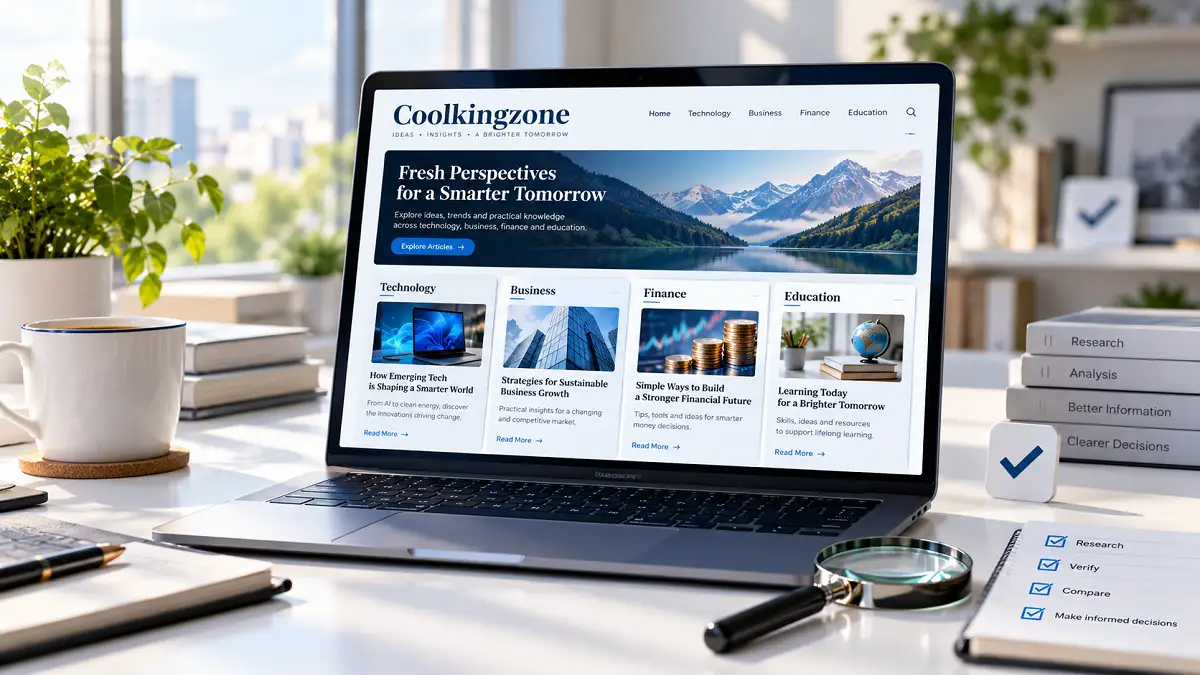
Coolkingzone com refers to CoolKingZone.com, a general-interest publishing website associated with articles on technology, business, finance, education, health, travel, and other subjects. It is best understood as an online magazine or blog, not a dedicated software product or a specialist advisory service. Readers can use its articles to learn the basics of a topic, but should check the writer, date, evidence, and original sources before acting on important claims.
There is one research limitation. On October 31, 2026, direct requests to the site’s homepage were blocked with an HTTP 403 response. The content overview below therefore draws on recent public descriptions and reported search-indexed listings, not a complete inspection of the live website.
Table of Contents
What Is Coolkingzone com?
CoolKingZone.com is described by several recent independent website guides as a publication that brings unrelated topics under one domain. Instead of concentrating exclusively on technology or finance, it groups informational articles into subject areas that serve different readers.
The name can appear in searches on very different subjects. A visitor looking for an introductory explanation has different needs from a person seeking verified financial, medical, or legal guidance.
Its reported format is mainly editorial: individual articles, category listings, and general explainers. Descriptions of its content do not establish that it operates an online store, professional advisory business, or official app. Those are separate claims that would need their own evidence.
What Does CoolKingZone.com Publish?
Published descriptions of the site repeatedly mention technology, finance, business, education, health, law, travel, and automotive topics. Some also identify fashion, lifestyle, and related consumer interests. This is a reported subject range, not a certified inventory of every category currently visible on the site.
Technology and Digital Topics
Technology coverage is among the subjects most often associated with CoolKingZone.com. For someone arriving through a search engine, this could mean an introductory explanation of a digital service, online marketing topic, or business technology.
Business and Finance
The site is also described as publishing business-related and financial information. Reported finance listings include a discussion of Applied Epic accounting, an insurance agency management product. That is a more specific example than general articles about saving money or following markets.
A reader might use such an article to learn unfamiliar terminology or identify questions to ask a vendor. However, a blog post cannot by itself establish current product capabilities, accounting requirements, investment suitability, or regulatory obligations. Compare significant claims with original product documentation and applicable official guidance.
Education and Student Resources
Education is another regularly reported section. Publicly discussed examples include studying in Japan from India and books for NEET exam preparation. These examples show that material associated with the site is not necessarily written for US students or US academic systems.
Health, Travel, and Everyday Interests
Other descriptions connect CoolKingZone.com with health information, travel, automotive subjects, law, and lifestyle reading. Those areas differ widely in the consequences of following advice.
A general travel article may be useful for generating ideas. A treatment suggestion, insurance interpretation, or legal claim demands stronger support. The presence of a category says what the publisher discusses; it does not confirm that every article has been reviewed by a qualified specialist.
How Its Content Model Affects Readers
A broad publication can help readers discover unfamiliar subjects without visiting a different site for every basic question. Category pages and article previews, where available, provide a simple starting point for browsing.
The trade-off is uneven subject expertise. Someone able to explain a general software concept may not be qualified to assess a medical study or financial regulation. That does not make the website’s articles useless. It changes how much weight a reader should give them.
How to Find and Assess an Article
Start with the specific question you want answered. Searching for “insurance agency accounting” is more useful than opening a broad finance category with no goal in mind. Once you find a relevant title, apply these checks before using the information.
1. Confirm the Website Address
The domain discussed here is coolkingzone.com. Similar names with different extensions appear in public search results, including .net and .org addresses. A matching brand word does not prove common ownership or an official relationship. Check the address bar before sharing information or following a link.
2. Look at the Author and Date
Find the article’s byline, publishing date, and any meaningful update note. A name is useful, but a byline does not automatically prove specialist qualifications or ownership of the publication.
The date matters most when information changes rapidly. A recent software walkthrough, exam requirement, tax explanation, or travel regulation may be more useful than an old one, provided the actual information is supported.
3. Follow the Source Behind the Claim
An article may refer to a study, a government policy, a product feature, or a reported statistic. Check whether it links to the original evidence. If the citation leads only to another blog repeating the same claim, the source chain may still be incomplete.
For instance, a finance article discussing an insurance platform should ideally point to the vendor’s current documentation for product-specific features. A story about school admission rules should connect readers with the school’s official requirements.
4. Separate Explanation From Recommendation
A page explaining what an investment term means is different from a page telling you which asset to purchase. Likewise, describing a medical condition is not the same as recommending treatment. Ask whether the author is offering background information, personal opinion, paid promotion, or professional advice.
If a page pushes one product while barely discussing alternatives or limitations, consider whether its purpose is partly promotional. That possibility does not make every claim false, but it raises the importance of checking independent evidence.
5. Check the Information Against Your Location
US readers should watch for advice written for other countries. A guide about India’s NEET examination, for example, may be entirely relevant to students preparing for that exam but not to an applicant navigating US college admissions.
Currency, school calendars, insurance rules, tax systems, and professional licensing standards are not interchangeable across countries. Confirm the jurisdiction before applying a recommendation.
6. Decide Whether the Stakes Require Better Sources
For casual reading, a clear article may be enough. For health decisions, the US National Library of Medicine’s MedlinePlus guidance on evaluating health information recommends considering who runs a site, who wrote the material, its sources, and how current it is. Discuss personal medical decisions with a qualified healthcare professional.
Use a similar evidence-first approach to money, legal matters, safety, and professional obligations. The greater the possible consequence, the stronger your source should be.
What Can Be Verified About Its Publishers?
Some third-party accounts identify contributor names and describe standard publisher-information pages. Others are less certain about editorial oversight and ownership. Those descriptions are not enough to confirm the legal owner, staff qualifications, or current editorial review process.
During this review, the homepage could not be accessed directly, so current contact information, disclosure practices, and editorial controls were not independently verified. Readers interested in a specific article should review the publisher’s live About, Contact, and policy pages if available.
Is Coolkingzone com Safe or Trustworthy?
Two different questions are often mixed together here. Technical safety concerns whether a page, link, form, or download could expose a visitor to harm. Editorial reliability concerns whether the information is accurate, fair, and supported by evidence.
The available research does not justify a definitive security verdict or a numerical trust score for CoolKingZone.com. An HTTP 403 restriction during research is an access result, not proof of malware, fraud, or a widespread outage. Appearing in a search engine also does not certify a website as safe.
If you receive an unfamiliar message that claims to represent a publisher, inspect the sender and destination carefully. The Federal Trade Commission’s phishing guidance explains how deceptive links and requests for personal information can be used in scams. Avoid entering payment details or downloading files simply because a link carries a familiar-looking name.
For content reliability, judge individual articles on their evidence rather than assuming every page on a multi-topic site meets one standard. A useful background explanation may still require independent confirmation before it becomes the basis for an important decision.
What If the Website Does Not Open?
A page can fail to load for several reasons, including access restrictions, temporary server rules, regional differences, or issues specific to a browser or network. The blocked request observed during this research does not identify the reason or prove every visitor will see the same response.
First check the exact spelling of the URL. If it remains inaccessible, avoid entering credentials into a lookalike domain. Search results may help identify an article title or previously indexed page, but their excerpts are not a substitute for the full current text.
Who Is the Website Most Useful For?
CoolKingZone.com may suit readers who want general introductions to unfamiliar subjects, ideas for further research, or articles across several everyday categories. Its broad reported coverage makes it less useful as a single final authority for specialist questions.
Students should verify academic requirements with schools or exam bodies. Business readers should check products with vendors. People researching health, personal finances, or law should turn to appropriate official and professional sources before making consequential decisions.
Frequently Asked Questions
Is Coolkingzone com only a technology website?
No. Recent public descriptions associate it with business, finance, education, health, travel, and additional subjects. Technology is one reported section, not its only focus.
Is CoolKingZone.com an online shopping platform?
The sources reviewed primarily describe an article-based publication. They do not establish a current retail checkout or e-commerce operation. Treat any specific purchase offer as a separate claim requiring verification.
Who owns CoolKingZone.com?
A legal owner could not be independently confirmed during this review. Contributor names shown in third-party accounts should not be mistaken for proof of domain or company ownership.
Can I cite articles from CoolKingZone.com in school or work?
You can read them for context and follow their references. For formal research, identify the underlying evidence and cite reliable original sources when possible. Check any applicable academic or workplace citation requirements.
Final Assessment
Coolkingzone com is best understood as a general-interest publishing website with reported content across technology, business, finance, education, and several other areas. Its value depends less on the number of categories than on the quality of the specific article you open.
Use it to discover a subject, then check dates, authorship, original sources, and local relevance. For decisions involving money, health, safety, or legal rights, confirm the facts with the organizations or professionals responsible for them.
1 comments